Reading a Global Story When You Do Not Recognize the Acronyms
Reading a global story with unfamiliar acronyms is easier when you sort the terms by type, check their expansions, and keep uncertainty visible in your notes.
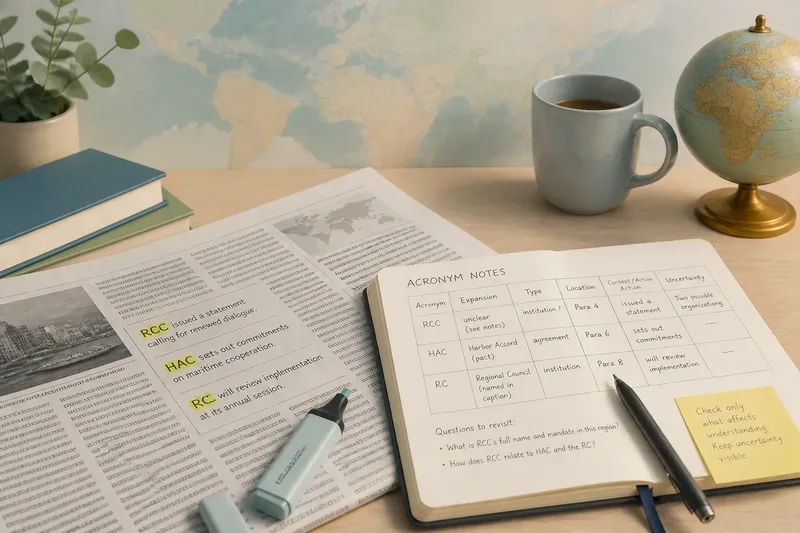
Which unfamiliar acronym can you safely leave unresolved while reading an international story? Start by identifying what kind of name it is and what the surrounding sentence says, then look up only the terms that affect your understanding. This approach to reading a global story with unfamiliar acronyms keeps a confusing cluster of initials from becoming a guessing game.
Mark unfamiliar acronyms before looking them up
An acronym is a shortened form made from the initial letters or syllables of a name. International reporting uses them for organizations, agreements, coalitions, operations, and groups of countries. The same short form can also have different meanings in different regions or fields.
On a first read, underline each unfamiliar acronym and note its paragraph. Add a question mark if the article does not provide an expansion. This gives you a map of the terms without interrupting the story to search for every one.
Notice the words around each acronym, too. A report may call it a commission, treaty, mission, or bloc. Those labels can help you classify the name, but they do not establish its full expansion or settle every detail of its role.
Classify the name by what it refers to
Use a short role note to distinguish the kinds of things a report names:
- Institution or organization: a continuing body, such as a commission, court, agency, or secretariat.
- Agreement: a treaty, accord, or protocol that sets terms for its parties.
- Group: a coalition, bloc, delegation, or set of participants acting together.
- Operation or mission: an organized activity, such as an observer presence or diplomatic effort.
- Unclear: a useful label when the story does not provide enough information to classify the term.
These categories are reading aids, not claims about authority or responsibility. A group might support an agreement, while an institution reviews its implementation; the names refer to different things even when they appear in the same sentence.
Say you are reading an invented report that mentions the Coastal Cooperation Group, the Harbor Accord, and a Regional Council. The article calls the first a bloc, describes the second as a pact, and says the third will review implementation. You could note “group,” “agreement,” and “institution” beside the names, while leaving any unstated relationship between them blank.
Keep a compact glossary and mark what is uncertain
A small glossary helps you return to the report without turning reading into a separate research task. For each term, record:
- Printed form: copy the acronym exactly as it appears, including punctuation.
- Expansion: write the full name only if the article supplies it or a reliable source confirms the same name in context.
- Type: note institution, agreement, group, operation, or unclear.
- Location: record where the acronym first appears, such as the paragraph or caption.
- Context: note the subject of the sentence and the action or description attached to the term.
If an expansion remains uncertain, write “unclear” rather than filling the space with a plausible guess. Similar initials can refer to separate entities, and a short form may be reused across languages or policy areas. Visible uncertainty is easier to correct than a confident mistake.
Use nearby words as clues, not proof
Terms such as “signed,” “ratified,” or “implemented” often appear near agreements. Words such as “issued,” “met,” or “monitored” may appear near institutions, while groups may be described as coordinating or calling for action. These patterns can suggest a category, but they cannot confirm an acronym’s expansion.
Check whether the story defines the term at first mention. If not, scan the headline, caption, and earlier paragraphs; a caption may spell out a name that the main text later abbreviates. If you search online, combine the acronym with a distinctive clue from the story, such as its country or policy area. Prefer a source that spells out the same name in that same context.
Do not treat an operation’s label as a full description. Calling something a “mission” does not by itself explain who organized it or how it relates to another body. Keep those open questions separate from the basic note about what the article calls it.
When should you stop to check an acronym?
Should you search the acronym online?
Search the short form together with a place or subject named in the report. Compare the result’s full name and context with the article rather than relying on a matching set of letters alone.
What if the article never gives the expansion?
Keep the acronym as printed and mark its expansion as unknown. You can still understand the sentence’s description while avoiding an unsupported definition.
Can the same acronym name different entities?
Yes, short forms can be reused across organizations, languages, and fields. Use the report’s region and subject to assess a possible match; if more than one remains plausible, record the alternatives without selecting one.
When does an unknown acronym matter enough to pause?
Pause when the term is central to the story’s decision, agreement, or stated process. If it appears only in passing, continue with an uncertainty note and return to it if the meaning changes how you read the surrounding passage.
Reread with the terms kept distinct
Return to the marked passages and substitute the category you recorded: “the agreement,” “the group,” or “the institution.” If the sentence becomes confusing, revisit the note rather than forcing an interpretation. The aim is to separate the kinds of entities named in the story, not to infer details the text does not provide.
Imagine an invented report says that an unnamed “RCC” issued a statement, while a treaty is due for review. You check the article’s headline and caption, then search “RCC” with the named region and policy area. Suppose the sources you consult still point to two possible organizations: record both possibilities, keep the expansion marked unclear, and read the rest of the report without assigning the statement to either one. The result is a clear boundary between what the article says and what remains uncertain.
For reading a global story with unfamiliar acronyms, the useful next question is not always “What do these letters stand for?” It may be “Does identifying this name change how I understand the passage?” If the answer is no, keep the uncertainty visible and move on; if it is yes, use the report’s specific context to guide a careful check.