Before the Date: How Calendars Shape Historical Timelines
Learn how calendars shape historical timelines so you can compare differently dated accounts without mistaking a written-date difference for a changed event.
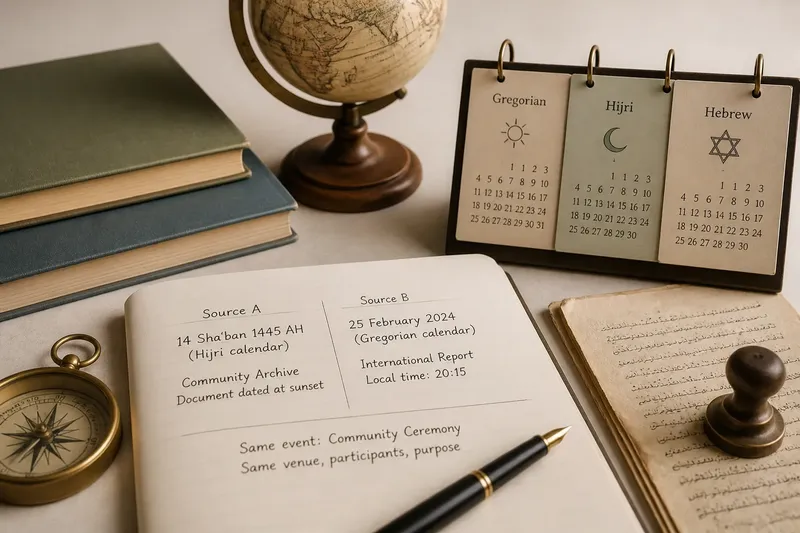
Why can two accounts give different dates for the same historical event? Often, the event is not in dispute: the accounts use different calendars, or one converts a date from one calendar into another. Reading historical timelines carefully means asking what calendar a date belongs to before treating a difference as a change in the past.
A calendar is a system for naming and organizing days. The Gregorian calendar is commonly used for international reporting, but it is not the only system people use to mark religious, civic, or cultural time. These distinctions matter when news stories, archives, and commemorations describe an event across borders.
1. Check which calendar the written date follows
A date such as March 10 looks self-explanatory, but its meaning depends on the calendar behind it. If an account names the Gregorian calendar, that identifies the system. If it gives a date without saying, the surrounding context may help, but silence is not proof that every source is using the same convention.
Sources may signal a calendar with a brief label, an explanatory note, or the name of a religious or national observance. A report may also use a familiar calendar in its main text while retaining a different calendar date in a quotation or document. Watch for that shift, especially when the story moves between an event description and a source’s own wording.
For a first check, look near the date for terms such as “Gregorian,” “Julian,” “Hijri,” or “Hebrew.” If there is no label, note that the calendar is unspecified rather than silently assuming one.
2. Separate the event from the date label
An event is something that happened: a meeting opened, a declaration was issued, or a ceremony took place. A calendar date is a way of locating that event within a particular system. The date label can differ even when the underlying event remains the same.
This separation helps prevent a common misreading. If one account places a ceremony on a date in one calendar and another gives its equivalent in a different calendar, the two lines may describe one occasion, not two occasions. Before drawing conclusions about sequence, identify whether the accounts refer to the same event and whether their dates use the same system.
Imagine a local archive records a ceremony using a community calendar, while an international report gives the corresponding Gregorian date. If both identify the same venue, participants, and occasion, the sensible first reading is that they are two date expressions for one event. A conversion tool or a clear source note can help confirm the relationship; the date difference alone does not establish a second ceremony.
3. Distinguish calendar conversion from a changed historical claim
Calendar conversion translates a date from one calendar into another. It does not, by itself, revise what happened. A changed historical claim is different: a source might correct the date, identify a new event, or challenge the evidence behind an earlier account.
Look at what else changes between the accounts. If the named event and its sequence remain stable while the calendar label changes, conversion is a plausible explanation. If the accounts disagree about the place, participants, or whether the event occurred before another event, the difference may need a broader explanation than calendar notation.
For a careful comparison, write the date exactly as each source presents it, including any calendar label. Then compare the event descriptions and the order of nearby events. That small record keeps a converted date from being mistaken for a correction.
4. Remember that calendars do not divide time in identical ways
Calendars organize years and months according to different rules. Some are solar, keeping the year aligned with the seasonal cycle; some are lunar, following the phases of the Moon; and some combine lunar months with adjustments to keep them in step with the seasons. As a result, dates in different calendars do not always align in a fixed way from year to year.
This is why a date conversion may need a year, not merely a month and day. In a lunar calendar, a named month can fall in different parts of the Gregorian year in different years. A religious observance may also begin at sunset, while another account locates the event by a civil day. The apparent mismatch can therefore involve both calendar rules and how a day is counted.
Do not infer that an observance has moved in the historical sequence simply because it appears under a different Gregorian month in another year. First ask whether the source is naming a lunar date, a civil date, or the start of an observance.
5. Treat dates near midnight with care
Some communities reckon a day from sunset to sunset; many civil calendars treat the day as beginning at midnight. An event after sunset can therefore fall on different named dates in accounts that use different day boundaries, even before a calendar conversion is considered.
Time zone differences can add another layer. A live event may occur on one civil date at its location and on the previous or following date for a distant audience. This is especially relevant for broadcasts, remote meetings, and events described from outside the place where they occurred.
When a date sits close to a boundary, look for the event’s local time and location if the source provides them. The local date is often the clearest anchor for placing an event in its immediate setting; an account’s publication date may simply reflect where its newsroom is based.
6. Read source conventions as part of the timeline
Archives, newsrooms, and institutions may follow different editorial conventions. One archive may preserve the date written on an original document, while a historian or editor adds a converted date for readers. A news report may use a civil calendar throughout, then quote a document that retains its original date.
Preserving an original date can be useful because it shows how a record was made and understood at the time. A converted date can make comparison easier for readers using another calendar. Neither choice automatically makes the account more accurate; what matters is whether the source explains the convention well enough for its reader to follow.
When an account supplies both dates, keep their roles clear. One may be the date as recorded in the source, and the other a conversion. Avoid treating them as competing claims unless the text indicates that the event date itself is disputed.
7. Compare timelines without forcing every date into one system
A shared timeline can still be useful when its entries use different calendars, as long as the distinction remains visible. You might record an event’s original date, the calendar named by the source, and a converted date where a reliable source provides one. If the calendar is unknown, mark it as unknown rather than guessing.
For example, imagine you are reading two accounts of a proclamation. One quotes a document’s date in a local calendar; the other gives a Gregorian date and describes the same proclamation. You could place both entries together in your notes, retain the original wording, and label the Gregorian form as a conversion if the source says so. That makes the connection legible without pretending the two written dates are identical.
- Copy each date as printed before converting it.
- Record the calendar label or note that none is supplied.
- Check whether both accounts describe the same event.
- Keep local time and place in view when the date is near midnight.
- Mark a conversion as a conversion, not as a second event or a correction.
What should you ask when dates do not match?
Does a different date mean the event happened twice?
Not necessarily. Check whether the accounts describe the same occasion and whether their date labels refer to different calendars or day boundaries before treating them as separate events.
Can a calendar conversion produce one exact answer?
It can depend on the calendar rules and the information provided, including the year and how the day is reckoned. Use a conversion that identifies its convention, and retain the source’s original date alongside the converted form.
What if a source does not name its calendar?
Look for clues in the document type, institution, language, and surrounding dates, but treat these as clues rather than certainty. If the calendar remains unclear, say so in your notes instead of assigning one without evidence.
How can I tell a conversion from a historical correction?
A conversion changes the calendar expression while preserving the event description; a correction changes the source’s claim about the event or its timing. Compare the wording, source notes, and sequence of events to see which kind of change is being made.
Keep both date forms visible when they explain the record
For global news literacy, the most useful habit is to treat a date as information with a context: a calendar, a place, and sometimes a particular boundary between days. When a historical timeline uses more than one convention, preserve the source’s wording and identify any conversion rather than quietly replacing one form with another.
That approach makes historical timelines easier to compare without suggesting that the past itself shifted. If a source leaves the calendar uncertain, keep that uncertainty attached to the date; it is more informative than a confident-looking conversion that the evidence cannot support.